DeNovo Longevity
Muscle Oxygen & Blood Flow Assessment
Muscle Oxygen & Blood Flow Assessment
Couldn't load pickup availability
Powered by NIRS technology
Find out whether your performance ceiling is delivery or utilization — and train the right limiter.
Most performance tests tell you how much oxygen your body can use. Almost none tell you where the bottleneck actually is. When you hit the wall in a workout, is your cardiovascular system failing to deliver enough oxygen to the muscle? Or is the muscle itself failing to extract and use what's already there? Those are two completely different problems — and they require two completely different training responses.
The Muscle Oxygen & Blood Flow Assessment answers that question directly.
What It Measures
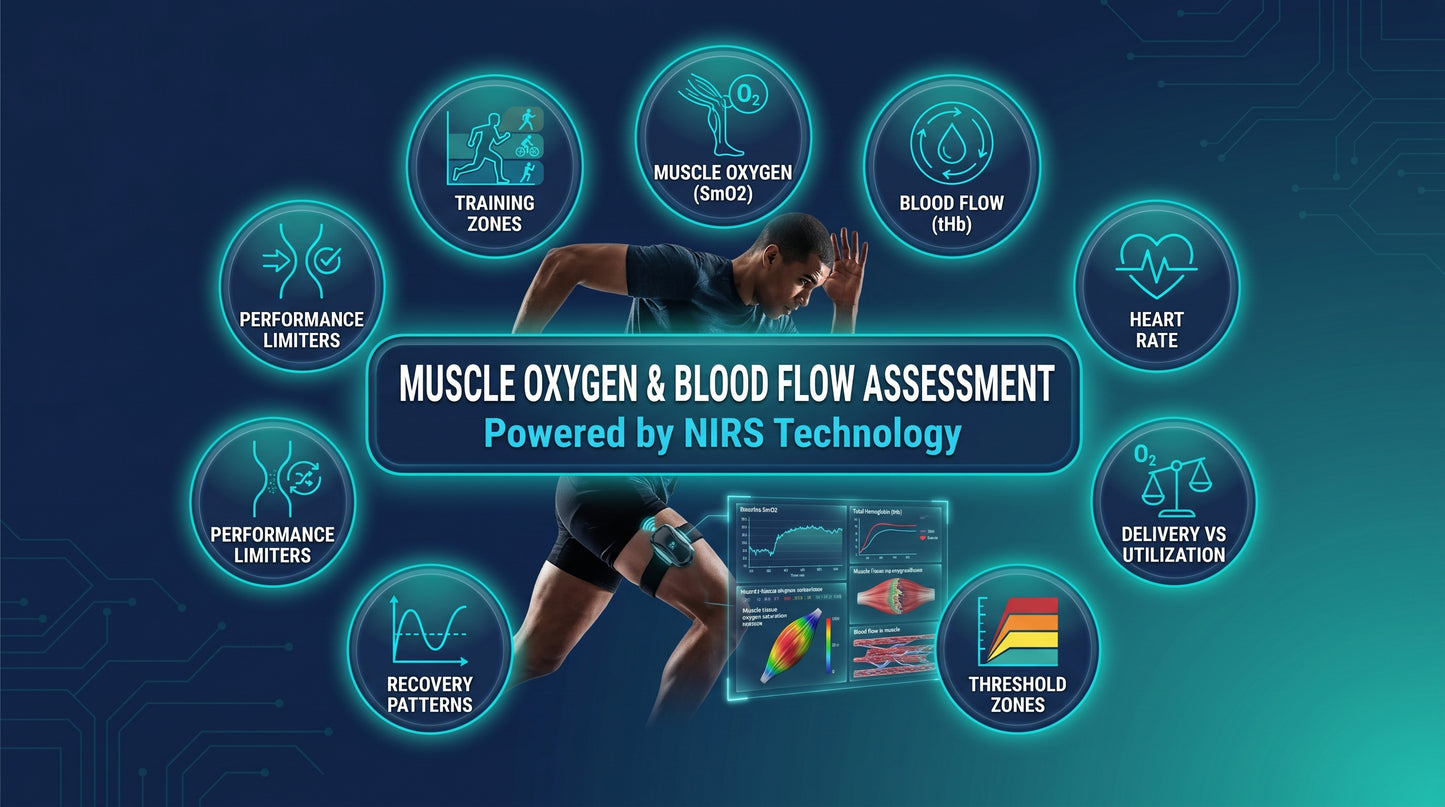
Using a professional-grade near-infrared spectroscopy (NIRS) sensor placed on the working muscle, paired with a heart rate monitor, this assessment captures three signals in real time across a graded exercise protocol:
- Muscle Oxygen Saturation (SmO2) — the percentage of oxygen saturation inside the working muscle tissue itself. This is the key signal almost no other test captures. It shows how well your muscle is using oxygen at every intensity, not just how much is in your bloodstream.
- Total Hemoglobin (tHb) — a measure of blood volume in the muscle. It reveals how efficiently blood is being delivered to and cleared from the tissue under load, exposing circulatory limiters that arterial blood tests can't see.
- Heart Rate — overlaid against your muscle-level data to map cardiovascular load against tissue response, intensity by intensity.
Together, these three signals build a complete picture of your personal oxygen cascade — from heart to bloodstream to muscle to mitochondria — and identify exactly where your performance is being limited.
Why It Matters
VO2 Max tells you the size of your engine. This test tells you how the engine is actually running under load. Two athletes with identical VO2 Max scores can have completely different limiters — one delivery-bound, one utilization-bound — and their training prescriptions should look nothing alike. Without NIRS data, you're guessing.
This assessment removes the guesswork. The result is a precision training framework built around your actual physiology, not population averages.
Who It's For
- Endurance athletes optimizing pacing, threshold work, and recovery strategy
- Strength and power athletes looking to extend repeated-effort capacity
- Performance-focused adults who've already tested VO2 Max and want the next level of resolution
- Anyone using structured training (cycling, running, rowing, hybrid) who's stopped progressing on volume alone
- Customers exploring breathwork, altitude protocols, or hypoxic training who want objective feedback on adaptation
What's Included
- Pre-test consultation to align on goals and protocol
- In-person assessment using professional NIRS sensors, heart rate monitor, and a graded exercise protocol matched to your primary sport
- Real-time data capture across rest, work, and recovery
- A detailed report identifying your delivery vs. utilization profile, threshold zones, and recovery characteristics
- Post-test review with a DeNovo Longevity specialist to translate the data into a clear training framework
Pairs Powerfully With VO2 Max
VO2 Max measures the size of your aerobic engine. The Muscle Oxygen & Blood Flow Assessment shows how that engine performs at the tissue level. Together, they deliver the complete oxygen cascade — from breath to working muscle — and form the most comprehensive at-clinic performance profile DeNovo Longevity offers.
Logistics
This assessment is conducted in person at a DeNovo Longevity partner facility. Sessions typically run 60–75 minutes, including pre-test setup, the graded protocol, and your post-test review. Your full report and data are delivered through the DeNovo Longevity portal.
This panel is intended solely for informational and wellness purposes to help inform lifestyle choices. It is not intended for diagnostic purposes and is not a substitute for medical advice. Please consult a licensed healthcare practitioner for any questions regarding diagnosis, prevention, or treatment of any disease or health condition.
Share